Gamescom is supposed to be the big quest marker on an indie developer's calendar. You spend months polishing a demo, burn a painful amount of money on travel and booth space, and hope one meeting in Cologne changes your game's trajectory. For several exhibitors at Gamescom 2026, that dream run instead became a hardware theft nightmare.
Solo developer Ryan Laley, publisher iam8bit and Tessera Studios all reported equipment stolen from their stands during the event. The known losses include multiple laptops, a Steam Deck and machines holding unfinished game builds. Police reports have been filed, Gamescom says investigations are underway, and nobody has publicly identified a suspect.
That last point matters. There are real questions about how equipment could leave controlled event spaces, but there is currently no evidence tying any security guard to the thefts. A separate investigation into security staffing at Gamescom 2025 has resurfaced during the backlash. It adds uncomfortable context, but it does not solve the 2026 case.
Ryan Laley arrived to find his Gamescom effectively over
Laley was at Gamescom to show Mimic on Steam, his upcoming asymmetrical multiplayer survival horror game. On the morning of August 28, he said he returned to the business area and discovered that the laptops used at his booth had disappeared overnight.
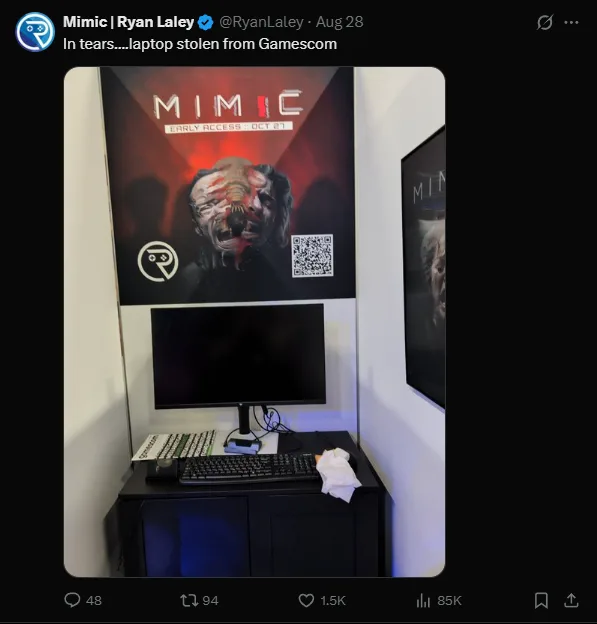
Click the image above or watch Ryan Laley explain the Gamescom theft in his video on X to hear his account directly.
In the video, Laley fights back tears as he explains that his equipment was gone and that other exhibitors had also been hit. He called the loss financially and mentally crushing. For a solo developer, a demo laptop is not just another line on an insurance claim. It is the machine carrying the build, the meetings, the marketing opportunity and often a serious chunk of the studio's available budget.
Laley later told Kotaku's report on the thefts that he knew of at least seven or eight stolen laptops. He said exhibitors in the business hall had been told there was round-the-clock security and that equipment could not leave without authorization. Gamescom's later statement drew an important distinction between general venue security and security booked for an individual stand.
The community response landed much better. Developers, hardware companies and players offered help, while CD Projekt Red publicly offered to look for replacement hardware. Laley declined the idea of crowdfunding and instead asked people to wishlist and share Mimic. That is an admirably indie answer to an awful situation, but wishlists should not have to function as emergency equipment insurance.
The reported thefts went beyond one booth
Laley was not describing a single missing laptop in a public aisle. iam8bit reported that two laptops were taken overnight from its station in the business area. Those machines were being used to demonstrate Petal Runner and Escape Academy 2 to media and creators, and they contained unfinished builds prepared by Nano Park Studios and Coin Crew Games.
That turns a hardware theft into a potential data and release security problem. A stolen prerelease build can force a developer to rotate credentials, assess what files were exposed and prepare for the possibility of an unauthorized leak. Even when the source code is safely backed up, the disruption consumes time that a small team does not have.
Tessera Studios reported a separate incident at its stand in the Indie Area. The team said somebody forced open a locked storage cabinet and took two laptops and a Steam Deck while it was at Gamescom to showcase The Zibbo Show. Its firsthand account of the break-in says the studio filed reports with event security and local police.
The incidents were reported in different halls and on different mornings. That is why Gamescom's description of them as “individual cases” has attracted so much heat. The phrase may be intended to say that the thefts are not evidence of a venue-wide threat. To affected developers, it sounds like several connected warnings being filed into separate drawers.
Gamescom says stand security and insurance are separate
Gamescom acknowledged the reports on August 29. The event said uniformed guards provide general security throughout the venue, while exhibitors can separately book security for an individual stand. It also pointed exhibitors toward theft insurance and said those arrangements are covered in its participation terms and technical guidelines.
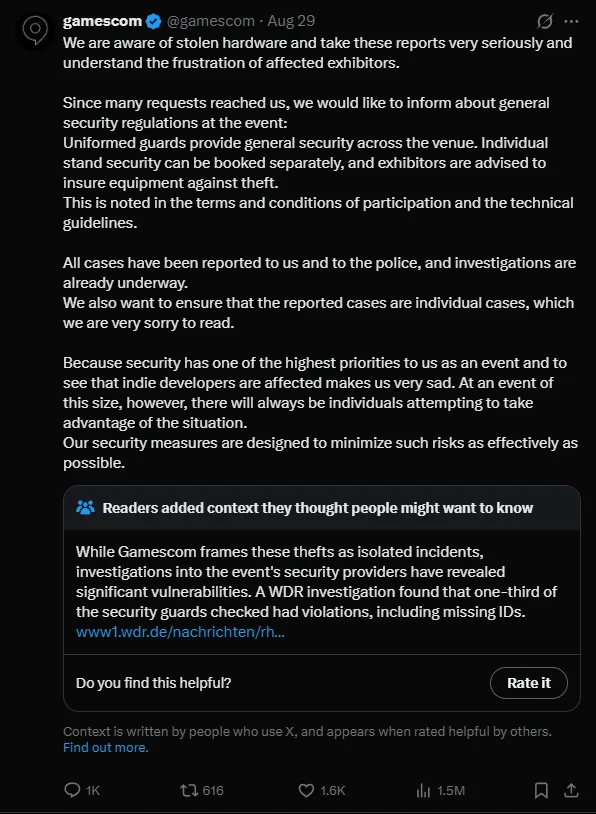
The statement also said the reported cases had been passed to police, investigations were already underway, and the event's security measures are intended to minimize risk. Gamescom expressed sadness that indie developers were affected and argued that an event of its size will always attract people trying to exploit the situation.
From Gamescom's point of view, the contract separates general hall supervision from dedicated protection for every computer on every stand. GamesWirtschaft's review of the exhibitor terms says the organizer disclaims custody and liability for exhibitor property, and allows companies to purchase dedicated stand guards.
That may explain Gamescom's legal position. It does not fully answer the operational question. If access is restricted after hours, what controls were in place, how did multiple devices leave, and what will change before another hall opens? Telling exhibitors to insure their gear addresses who absorbs the bill after a theft. It does not explain how the theft happened.
IndieGameJoe says the response misses the actual loss
Streamer and developer advocate Joe Henson, better known as IndieGameJoe, published a blunt response after reading Gamescom's statement. He argued that the affected booths included business areas not open to the general public, while the Tessera theft involved a locked cabinet that had been forced open.
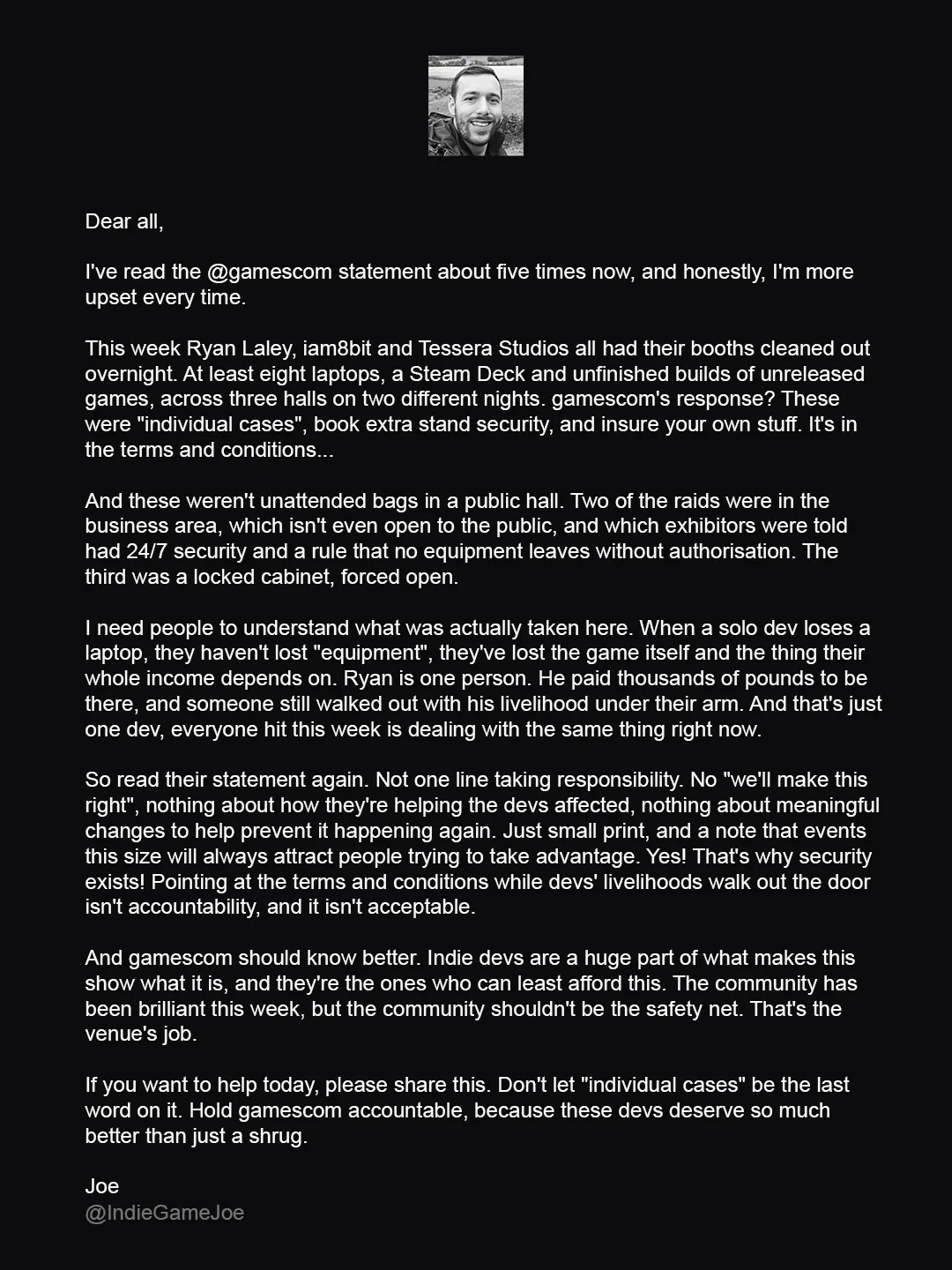
His core point is bigger than the replacement price of a laptop. When a solo developer loses a primary work machine at the show they paid to attend, they can lose their playable build, scheduled meetings and the chance to pitch the project supporting their income. A larger publisher can swap in another unit and keep the booth running. A one-person studio may simply be done for the week.
Henson also objected to the absence of a public commitment to help the affected teams or announce concrete security changes. His sharpest summary was that the indie community “shouldn't be the safety net.” That criticism hits because the community did immediately begin the recovery quest, while the organizer's first response led with rules, insurance and separately purchased protection.
There is a fair distinction between accountability and automatic legal liability. An investigation may find that an authorized attendee, a contractor or somebody else exploited a gap. Gamescom does not need to guess publicly before police establish facts. It can still describe immediate safeguards, explain what support is being offered and tell exhibitors when they should expect the next update.
The “illegal security guards” story is real, but it is from 2025
One image circulating beside the 2026 theft reports carries the headline “Illegal security forces deployed at Gamescom?” It comes from German public broadcaster WDR, and the underlying report is genuine. It is also dated August 23, 2025, one year before these thefts.
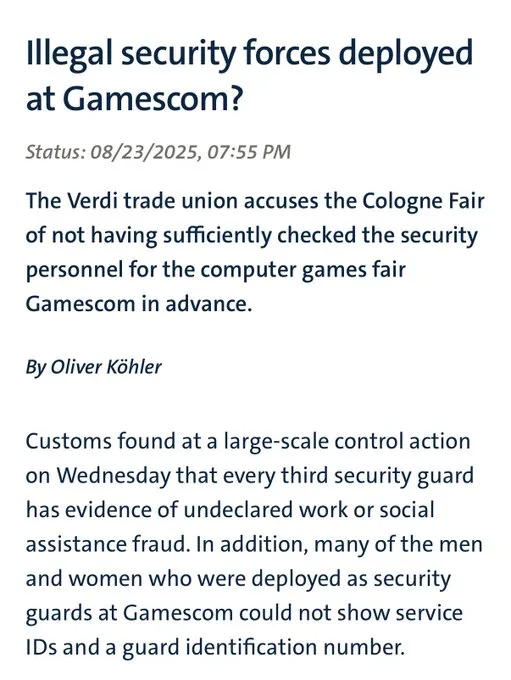
WDR reported on a customs inspection at Gamescom 2025 that checked 150 security workers. According to the broadcaster, roughly one third of those checks produced indications of undeclared work or social-benefit fraud, and many workers could not show the required service identification or guard ID number. The Verdi trade union accused Koelnmesse of insufficient screening.
Koelnmesse told WDR that it conducted spot checks in coordination with local authorities and complied with its legal responsibilities. It also said it was not authorized to inspect criminal records. WDR reported that all but one of the checked workers remained deployed while the findings were being assessed, and Koelnmesse promised to review the customs results and respond quickly to violations by service providers.
Those are serious findings about the 2025 event. They make renewed scrutiny of contractor vetting reasonable. They do not establish that improperly documented guards worked at Gamescom 2026, and they do not show that a guard stole any of the missing devices. Calling the current theft an inside job would be speculation, not reporting.
The responsible question is narrower: after the issues identified in 2025, what changed in the selection, verification and supervision of security contractors for 2026? Gamescom's current statement does not answer that question.
Insurance is not a substitute for a functioning show
There is an obvious practical lesson for anyone exhibiting at a convention: encrypt drives, use clean demo machines, keep cloud backups, rotate exposed credentials, attach physical locks and remove portable hardware overnight whenever possible. Indie teams should plan as if every expo is a hostile environment, because one stolen drive can become a much larger security incident.
That advice cannot become an excuse to blame the victims. Tessera says its cabinet was locked. Laley says the business area was presented as controlled around the clock. iam8bit lost hardware containing unreleased builds from a space intended for industry meetings. Reasonable precautions and organizer accountability can exist in the same sentence.
This story also exposes the ugly economics behind the polished convention floor. An indie booth already means travel, accommodation, equipment, staffing and days away from development. We have written before about the relentless work behind building an indie game in public and the devlog grind required to earn wishlists. Losing the machines needed for the pitch can wipe out that investment before the first useful meeting.
Gamescom is right that no event can reduce theft risk to zero. Its critics are right that this is not the finish line for the response. Exhibitors now need facts about access, contractor oversight and any changes coming from the investigation. The affected developers need more than sympathy and a reminder to read the terms.
Until police or Gamescom release further findings, claims about who committed the thefts remain rumors. What is already on the record is bad enough: several indie-facing booths lost essential hardware, at least one locked cabinet was reportedly forced, unfinished builds may have been exposed, and a solo developer's biggest week of the year was derailed overnight.
Catch more stories from the people actually making games in our Gaming News section.
 Written by
MML Tech →
Written by
MML Tech →